Wait... you can actually *hear* your thoughts as words?
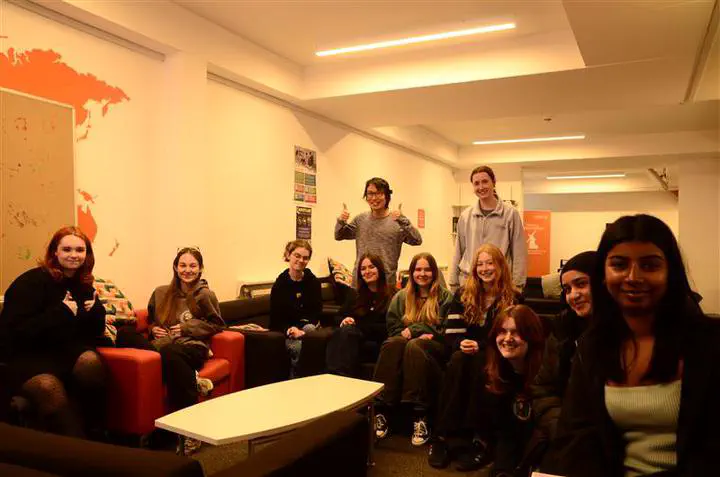
“Wait… you can actually hear your thoughts as words?”
A visitor stared at our thought diversity map in disbelief, their finger hovering over the ‘abstract/non-verbal’ quadrant where they’d just placed their marker. Across the room, someone else had confidently positioned themselves in ‘vivid/verbal’ territory. Same human brain. Completely different inner worlds.
This moment of mutual discovery – repeated dozens of times throughout the day – is exactly why we built what we’re calling the “Voicescape Installation.”
From Prototype to Performance: The Voicescape
After two workshops of testing, tweaking, and learning from feedback, we’ve created something rather special: an interactive installation where you don’t just describe your inner experience – you perform it.
The centrepiece is our refined launchpad player. Press the illuminated keys and you’ll trigger real voices – actual recordings from young people who shared their inner thoughts in our previous workshops. Layer them over ambient soundscapes. Create patterns. Build your personal voicescape from the mental experiences of others.
Here is a track made by our artist:
It’s curious and oddly intimate. You’re literally composing with someone else’s ‘inner’ voice, while simultaneously externalising your own thought patterns through the combinations you choose. Some visitors created chaotic symphonies of overlapping thoughts. Others carefully selected single voices, letting them breathe in the space. Each performance was a window into how that person experiences their own mind.

The “We Need to Talk” Experiment
But the real revelation came from our simplest activity.
We asked visitors to write down/draw their chain of thoughts upon receiving a text message: “We need to talk.”
The reactions were instant, that shared recognition of dread. But what came next was the interesting part. The drawings looked completely different from one another. Some people sketched spiralling loops, others branching trees of possibility, others wrote out full internal conversations. No two thought chains were alike, yet they all started from the same five words.
Mapping the Invisible: Where Do You Think?
We also set up a thought diversity map, two axes (abstract to vivid, verbal to visual) creating four quadrants of mental experience. Visitors placed coloured markers where they felt their thinking style belonged. What struck us was the scatter: no single cluster, no dominant pattern.
Several visitors moved their marker after seeing where others placed theirs. “I genuinely thought the way I think was just… thinking,” one explained. “I didn’t know it was a type of thinking.”
What Your Brain Looks Like When It Talks to Itself
Between voicescape performances, we demonstrated our EEG technology – the science beneath the art.
Electrodes. Brain waves. Real-time visualisations of neural activity during inner speech.
“So you can see when someone’s thinking in words?” a visitor asked, watching the screen as we demonstrated.
Not exactly – but we can detect patterns associated with language production, even when nothing is spoken aloud. That little voice in your head? It creates measurable electrical activity. Your silent reading of this sentence? Your brain is lighting up language centres right now.
For many visitors, this was the bridge between subjective experience and objective science. Your inner world isn’t just psychological – it’s neurological, electrical, physical. It’s real in ways that can be measured, studied, understood.

The Great Kahoot Showdown
We closed with what can only be described as delightfully nerdy chaos: a Kahoot quiz on inner speech, consciousness, and mental health.
Questions ranged from “What percentage of people experience no inner voice at all?” (around 5–10%) to “Can your inner speech affect your confidence?” (yes, and here’s the research to prove it).
The competition was fierce. The learning was real. And most importantly, people were excited about neuroscience and psychology – not because we lectured, but because we’d just given them tools to explore their own minds.
The winner received bragging rights and a small prize. Everyone left with something more valuable: language to describe their inner experience, and the awareness that their way of thinking is both unique and valid.
What We’ve Learned (And What Happens Next)
Three workshops in, here’s what’s become clear:
People are hungry to understand their own minds. Not in abstract, academic terms – but through direct exploration and comparison with others.
Art makes science accessible. The voicescape installation communicated more about inner experience in five minutes than any lecture could in an hour.
Diversity is the norm. There is no “standard” way to think. There’s only a spectrum of experiences, all equally real, all equally valid.
Community amplifies discovery. Every workshop participant teaches us something new – about methodology, about communication, about the sheer variety of consciousness itself.
Join the Conversation
The Voices of the Mind project continues to evolve, and we want you to be part of it. We’re planning:
- Touring the installation to more venues across the UK
- Expanding our thought diversity research with new activities and measures
- Building an online community for ongoing conversations about inner experience
Want to stay connected? »Join our mailing list« for behind-the-scenes updates, upcoming events, and fascinating science about the mind.
Because the most interesting conversation you can have isn’t with someone who thinks like you – it’s with someone who thinks completely differently, and helps you understand your own mind in the process.
What does your voicescape sound like?
More Info: